Griffin Technology

Griffin Technology designs and manufacturers computer peripherals, consumer electronics, and accessories. Founded in Nashville, Tennessee in 1992 by Paul Griffin, the first products were primarily video adapters. In particular those to enabling the connection of DB-15 based Macintosh computers to the more popular VGA based monitors. June of 1998 marked Griffin's entry into USB based computer peripherals with the introduction of the iMate, which allowed the use of Apple Desktop Bus (ADB) based devices with the newer, and increasingly more common, Universal Serial Bus (USB). Griffin introduced additional USB devices, such as the iMic and PowerMate, over the next two years, and continued to enjoy moderate growth during this period.

Griffin was one of the first companies to recognize the potential of Apple's iPod and introduced their first iPod accessories in January of 2002 at the MacWorld held in San Francisco, California. This was just three months after the the release of the iPod. One year later, at MacWorld San Francisco 2003, Griffin introduced the iTrip. The iTrip allows iPod owners to transmit audio from an iPod to a nearby FM receiver.

The company experienced rapid growth fueled by the success of its iPod accessories, especially the iTrip. As evidence, the number of people employed by Griffin Technology increased by over 400% between 2003 and 2007. This growth allowed the company to take on more ambitious
projects such as the Evolve wireless speaker system and, ironically, to diversify the product line to include accessories for iPod competitors such as Microsoft's Zune, and SanDisk's Sansa.

Nike+iPod

The Nike+iPod Sports Kit is a device which measures and records the distance and pace of a walk or run. The Nike+ consists of a small accelerometer[1] attached to or embedded in a shoe, which communicates with a receiver plugged into an iPod nano. iTunes software can be used to view the walk or run history. The kit was revealed on May 23, 2006 but for a short time was unavailable for purchase. The kit is able to store information such as the elapsed time of the workout, the distance traveled, pace, or calories burned by the individual wearing the shoes, and display it on the screen or broadcast it through the headphones of an iPod.

The kit consists of two pieces: An accelerometer with a transmitter that is mounted under the inner sole of the shoe and a receiver that connects to the iPod. Nike recommends that the shoe be a Nike+ model with a special pocket in which to place the device. Users who don't want to change shoes place the accelerometer in a cavity which they create under the insole of an ordinary shoe or attach it to the laces with a pouch or other means. The battery in the transmitter is not removable so the entire kit must be replaced when it expires.

In addition to the audio feedback provided by a generic male or female voice (user's choice), there are pre-recorded congratulations provided by Lance Armstrong and Paula Radcliffe whenever a user achieves a personal best (such as fastest mile, fastest 10K, longest run yet) or reaches certain long-term milestones (such as 250 miles, 500 kilometers). This "celebrity feedback" is heard after the usual end-of-run statistics.

On October 19, 2006, new features were added to the Nike+ website, including the ability to name runs. Forums were also added, allowing users to meet and challenge other runners, ask questions, and give feedback.

Privacy concerns were raised when graduate students T. Scott Saponas, Jonathan Lester, and Carl Hartung at the University of Washington discovered security flaws in the device that can be exploited to track the user.[1] [2] According to their research, the students discovered that the Nike+iPod transmitter gives off radio frequencies that can be read up to 60 feet away using RFID. During the test, students built a $250 surveillance device and integrated it with Google Maps, easily tracking the movement of the person wearing the Nike+iPod transmitter. Although no personal data is stored in the transmitter's chip, an RFID privacy concern was raised after the students were easily able to track the movement of the person, claiming that its tracking ability could be used for surveillance by scanning the data and linking it to a user's identity.[3]

Nike+iPod Sports Kit

ipod Accessories

Many accessories have been made for the iPod. A large amount are made by third party companies, although many are made by Apple. This market is sometimes described as the iPod ecosystem.[13] Some accessories add extra features that other music players have, such as sound recorders, FM radio tuners, wired remote controls, and audio/visual cables for TV connections. Other accessories offer more unique features like the Nike+iPod pedometer and the iPod Camera Connector. Other notable accessories include external speakers, wireless remote controls, protective cases/films and wireless earphones.[14] Among the first accessory manufacturers were Griffin Technology, Belkin, JBL, Bose, Monster Cable, and SendStation.

Two designs of iPod earbuds. The revised version is shown on the right.

The white earphones (or "earbuds") that ship with all iPods have become symbolic of the brand. Advertisements feature them prominently, often contrasting the white earphones (and cords) with people shown as dark silhouettes. Apple has once revised the shape of the earphones, claiming that the new ones fit better in more ears and provided better quality. The original earphones came with the first through early fifth generation (video) iPods, the iPod mini, and the first generation nanos, and the second type was shipped with late fifth generation iPods and the second generation nanos. All first generation iPod shuffles and the second generation up until January 30, 2007 (when color models were introduced) had the first kind; those that shipped after that date had the second kind.

In 2005, New York's Metropolitan Transportation Authority placed adverts on the subways warning passengers that "Earphones are a giveaway. Protect your device",[15] after iPod thefts on the subway rose from zero in 2004 to 50 in the first three months of 2005.[16]

BMW released the first iPod automobile interface,[17] allowing drivers of newer BMW vehicles to control their iPod using either the built-in steering wheel controls or the radio head-unit buttons. Apple announced in 2005 that similar systems would be available for other vehicle brands, including Mercedes-Benz,[18] Volvo,[19] Nissan, Alfa Romeo, Ferrari,[20] Acura, Audi, Honda,[21] Renault and Volkswagen.[22] Scion offers standard iPod connectivity on all their cars.

Some independent stereo manufacturers including JVC, Pioneer, Kenwood, Alpine, Sony, and Harman Kardon also have iPod-specific integration solutions. Alternative connection methods include adaptor kits (that use the cassette deck or the CD changer port), audio input jacks, and FM transmitters such as the iTrip — although personal FM transmitters are illegal in some countries. Many car manufacturers have added audio input jacks as standard.[23]

Beginning in mid-2007, four major airlines, United, Continental, Delta, and Emirates reached agreements to install iPod seat connections. The free service will allow passengers to power and charge their iPod, and view their video and music libraries on individual seat-back displays.[24] Originally KLM and Air France were reported to be part of the deal with Apple, but they later released statements explaining that they were only contemplating the possibility of incorporating such systems.[25]

What is MP3 Audio?

MPEG is an acronym for the Moving Picture Experts Group. This committee is responsible for developing international standards for compression in motion picture and studio applications. One such standard is MPEG-1 Layer-3, commonly referred to as MP3.

MP3 is a technique used to compress audio signals by a factor of about 12. The compression process is based upon limitations of the human ear. For example, sounds that immediately follow a sudden loud musical passage tend to be masked by the loud sound. Also, the ear has difficulty in distinguishing closely spaced tones. MP3 processing eliminates those sounds that the ear cannot hear or has difficulty hearing. The result is a smaller or compressed digital package that can be easily sent over the Internet or recorded.

IEEE Spectrum, September 2004

Collecting MP3 Portables

BY RICHARD MENTA

Web Edition

Richard Menta offers a suggestion for collectors who give thought to what might be valuable years from now. Why not think of today's MP3s as the Regency TR-1s of the future? (Editor)

All collectors wish they could return to 1954 and pick up a new and perfect Regency TR-1 transistor radio or to the 1930s to preserve a rare prewar set. It occurred to me that, as editor of MP3 Newswire, I had inadvertently collected many of the first generation MP3 portables as I reviewed them for publication. Aren't these players today's Regency TR-1? If so, wouldn't now be a great time to start collecting these early portables, when they are easily available and cheap?

Contemporary audio equipment is not always something an antique collector strives to acquire, but I could easily see how 30 years from now some of these digital music players could be coveted. I already brought a box filled with several early players to my New Jersey Antique Radio Club meeting last year, and while the reaction was mixed (this was new technology, after all), their distinct styles and dramatic shapes were a welcomed respite from today's generic radios.

MP3s with Collecting Promise

For those who are intrigued by my suggestion here is a list of the key MP3 portables with the best collecting promise, all of which I reviewed when first released.
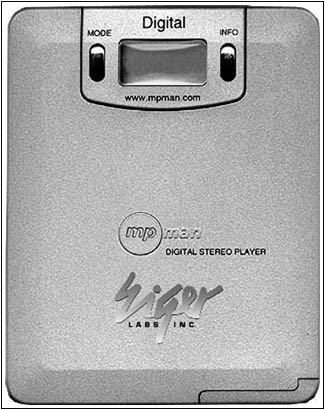
 
The Elger Labs MPMan F10
Figure 1. The Elger Labs MPMan F10, the first MP3 player, appeared in 1998.
 

Eiger Labs MPMan F10. Appearing in 1998, the MPMan, shown in Figure 1, was the first MP3 player. Spartan and square, the F10 sold for $250 and came with 32MB of memory. At a rough average of 1MB for every minute of music, the player could hold eight 4-minute songs. Not a lot, but it sold well. You could upgrade the memory to 64MB by sending the unit back to Eiger labs with a check for $69 plus $7.95 shipping.
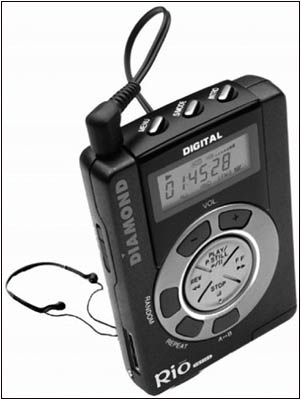
 
Diamond Rio PMP300
Figure 2. Diamond Rio PMP300, the second MP3 portable, put MP3 on the map, as it became a hit for the 1998 Christmas market.
 

Diamond Rio PMP300 (1998). It was the commercial success of this second MP3 portable that put MP3 on the map. Following the MPMan by just a couple of months, the 32MB Rio PMP300, shown in Figure 2, became a surprise smash hit for the Christmas '98 season. Sales far exceeded expectations and stayed strong long after the holiday.

This success convinced many that digital music was the future, and before long, dotcom money poured into online digital music initiatives and start-up MP3 portable companies. The impact of this little player was so strong that the record industry sued Diamond, claiming it encouraged music piracy. The record industry lost the case.
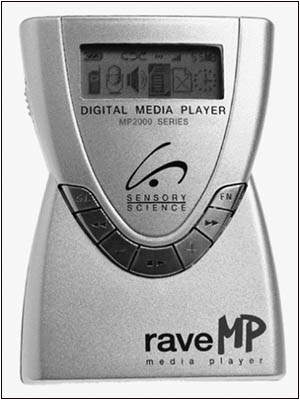
 
The 1999 Sensory Science RaveMP 2100
Figure 3. The 1999 Sensory Science RaveMP 2100 was the first player to have 64MB of built-in memory.
 

Sensory Science RaveMP 2100 (1999). Released in the summer of 1999, the RaveMP 2100, shown in Figure 3, was the first player to appear with 64MB of built-in memory, doubling the amount of music that users could listen to out of the box. Furthermore, an expansion slot allowed the unit to expand to 96MB. With a built-in microphone, this set was the first unit to add voice record capabilities.
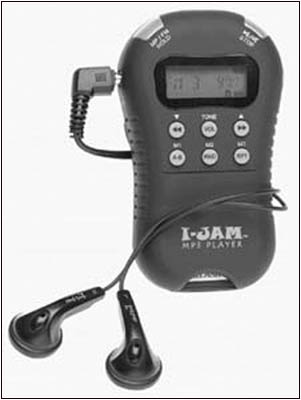
 
The I-Jam IJ-100
Figure 4. The I-Jam IJ-100 was a strong seller with its tiny dimensions and offer of a radio and a choice of five colors.
 

I-Jam IJ-100 (1999). With dimensions of only 3 inches long and 1/2 inch thick, the I-Jam, shown in Figure 4, proved how tiny MP3 portables could be. Weighing only 2.5 oz., the 32MB I-Jam included an FM radio and came in five colors -- the first player to offer either option. Colors included Black Rhino, Silver Bullet, Lemon Drop, Razz Jazz Red, and Chi-Town Blue. It was a strong seller, but the undercapitalized I-Jam Company ran out of funds and folded in 2002.
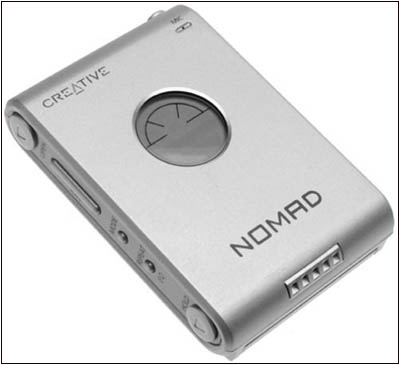
 
The Creative Labs Nomad
Figure 5. The Creative Labs Nomad.
 

Creative Labs Nomad (1999). This 32MB portable, shown in Figure 5, was introduced in June of 1999 for a healthy $429. It came clad in a magnesium body, and like the RaveMP, it had voice recording and an FM tuner. The Nomad was the first to offer a docking station so users didn't have to mess with wires every time they wanted to refresh songs on the player.
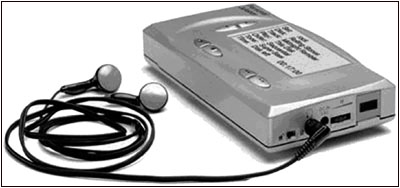
 
Remote Solutions Personal Jukebox PJB-100
Figure 6. Remote Solutions Personal Jukebox PJB-100.
 

Remote Solutions Personal Jukebox PJB-100 (1999). By the fall of 1999, all MP3 portables came with either 32MB or 64MB of memory, capable of holding only 7 to 20 song files at a time. This was the most limiting factor of early MP3 portables.

A company called Remote Solutions smashed that limitation with a clever idea. By utilizing a laptop hard drive for storage rather than low capacity flash memory, they produced a unit that held over a thousand song files, thereby inventing a jukebox MP3 portable. Listing for $799, the PJB-100, shown in Figure 6, premiered at the end of 1999 with 4.8GB of storage, enough for 1,200 songs.

There was a trade-off for such high capacity, as the drive made the PJB-100 both large and heavy. The grandfather of the Apple iPod, jukebox portables are now the dominant type of MP3 player sold today.

All photos courtesy of the manufacturers.

(Richard Menta, 58 Cedar Ave., #1 Highland Park, NJ 08904)

Mp3 player Audio formats

Besides MP3, the main formats in use are WMA/PlaysForSure from Microsoft, AAC (the DRM version is from Apple) and ATRAC from Sony, all of which are mutually incompatible.

For those who want an open-source option, there is the Ogg audio format, the format used by Wikimedia Commons. Ogg is the container format for Vorbis, Theora, Speex, FLAC, and many others.

A huge amount of freely downloadable music is available in MOD format from sites such as The MOD Archive[3]. Most MOD files are composed by individuals who allow them to be freely distributed, unlike music by most commercial artists. While today's digital audio players generally do not support MOD files directly, progress is being made on that front with projects such as the TRAXMOD digital audio player. Apple iPod owners willing to run Linux on their iPods may also play MOD files through the MikModule program. For the time being, MOD files can be manually converted into a supported audio format with some music converter and/or player software. It should be noted that due to differences in the file formats, the resulting file will almost inevitably be larger and of slightly lower quality.

Mp3 player Equipment

Generally speaking, digital audio players are portable and use headphones, although users often connect players to car and home stereos. Some DAPs also include FM radio tuners and/or microphones for voice recording. Many players can encode audio directly to MP3 or other digital audio formats directly from a line in audio signal. Most have semi-permanent rechargeable batteries while others have conventional battery bays for disposable or rechargeable batteries.

Apple's iPod devices incorporate a proprietary dock connector that allows them to connect to accessories such as chargers, or active speakers with built-in charging, or even into car players. Accessories that use the dock connector are only compatible with iPods.

While early players tended to use flash memory, the development of tiny hard-disk drives of typically 10 to 40 Gbyte capacity made it possible to save entire music collections onto a digital audio player at reasonable cost. In 2006 the cost of external flash cards dropped sharply, largely because of the increasing popularity of the digital cameras, and this has made the use of external flash cards a more attractive option in music players. Such players allow different cards to be used for different groupings, such as classical or pop, with no limit to the size of the total collection. This concept also permits easy swapping of collections, but can lead to problems if the files are not saved in the same format. A few players, such as the SanDisk Sansa, will play files that have been dragged-and-dropped to the flash card on a personal computer, without the use of any special software, and will automatically cope with folders containing albums, displaying everything in terms of artist, track (song), or album. Others only play tracks, and get confused if these are placed in folders, and may even require special software to be used to format the card. As flash memory prices continue to drop, some commentators expect flash to take over from hard disk drives altogether. Currently, the microSD flash card, a tiny version of the Secure Digital (SD)card commonly found personal computer users, is being aimed at portable players and mobile phones, with a maximum capacity of around 4GByte. Micro-SD flash is readily converted into an SD size card (for use with a PC) by inserting it into an adapter shell. The use of external flash cards makes it possible in principle to move collections of music between personal players, portable players with speakers, home audio systems, and car players, though in practice car and home players that will handle MP3 files and folders properly, with tracks, albums and playlists selectable, are hard to find.

Flash digital audio players have even been incorporated into sunglasses, as demonstrated by the Oakley's "thump" model in 2004.

A number of manufacturers now produce Network MP3 players. These tend to be non-portable devices which have no storage of their own. Instead, they connect to a home Ethernet network, and receive a digital audio stream from some computer on the network. They are designed to connect to a home stereo, and are operated with a remote control. Slim Devices, Roku, and cd3o each produce a Network MP3 device.

Modular flash players are composed of two detachable parts: the head (or reader/writer) and the body (the memory). They can be independently obtained and upgraded (one can change the head or the body; i.e. to add more memory).

A new type of digital audio player has emerged as a result of satellite radio companies' push into popular markets in the North America (XM Radio [1] and Sirius). These devices [2] are linked to the paid subscriber's account in that the players record a certain number of programs, like a TiVo, and allows the user to listen to pre-recorded programs, often popular songs or talk shows, while on the run. This has caused the music industry to be concerned about the high-fidelity music becoming pirated secondary to the ease of recording. One such a recording device that conveniently records all the music, once hooked up a desktop computer, was successfully forced to stop being sold through the satellite radio companies' portals by the music industry.

ipod History and Design

iPod came from Apple's digital hub strategy, when the company began creating software for the growing market of digital devices being purchased by consumers. Digital cameras, camcorders and organizers had well-established mainstream markets, but the company found existing digital music players "big and clunky or small and useless" with user interfaces that were "unbelievably awful", so Apple decided to develop its own. Apple's hardware engineering chief, Jon Rubinstein, assembled a team of engineers to design it, including Tony Fadell, hardware engineer Michael Dhuey, and design engineer Jonathan Ive, with Stan Ng as the marketing manager. The product was developed in less than a year and unveiled on 23 October 2001. CEO Steve Jobs announced it as a Mac-compatible product with a 5 GB hard drive that put "1000 songs in your pocket."

Uncharacteristically, Apple did not develop iPod's software entirely in-house. Apple instead used PortalPlayer's reference platform which was based on 2 ARM cores. The platform had rudimentary software running on a commercial microkernel embedded operating system. PortalPlayer had previously been working on an IBM-branded MP3 player with Bluetooth headphones. Apple contracted another company, Pixo, to help design and implement the user interface, under the direct supervision of Steve Jobs. Once established, Apple continued to refine the software's look and feel. Starting with the iPod mini, the Chicago font was replaced with Espy Sans. Later iPods switched fonts again to Podium Sans — a font similar to Apple's corporate font Myriad. iPods with color displays then adopted some Mac OS X themes like Aqua progress bars, and brushed metal in the lock interface.

The name iPod was proposed by Vinnie Chieco, a freelance copywriter, who (with others) was called by Apple to figure out how to introduce the new player to the public. After Chieco saw a prototype, he thought of the movie 2001: A Space Odyssey and the phrase "Open the pod bay door, Hal!", which refers to the white EVA Pods of the Discovery One spaceship. Apple had previously registered the name "iPod" for Internet kiosks, but never put it to use.

ipod mini

The iPod mini is a smaller version of Apple Inc.'s iPod portable audio player. It was announced on January 6, 2004, and released on February 20 of the same year; a second-generation version was announced on February 23, 2005. The device operates on Macintosh and Windows PCs, and has limited third-party support for Linux and other Unix workalikes. The iPod mini line was officially discontinued on September 7, 2005 and replaced by the iPod nano line.

The iPod mini retained the touch-sensitive scroll wheel of the third generation iPod; however, instead of the four touch buttons located above the wheel, the buttons were made mechanical beneath the wheel itself—hence the name click wheel.[specify] To use one of the four buttons, the user must physically push the edge of the wheel inward over one of the four labels. Like its predecessors, the wheel was developed for Apple by Synaptics. The click wheel is now also used in the fourth and fifth generation iPods and the iPod nano; however, in the the nano and 5G iPods, the clickwheel is developed by Apple.

Above the wheel is a monochrome monitor that displays a menu or information about the selected track. Newer-generation iPods have since adopted color displays.

They are no longer sold in stores.

ipod shuffle overview

First generation

The iPod shuffle is designed to be easily loaded with a selection of songs and to play them in random order. According to Apple, owners of existing iPods had often left the music selection to "shuffle", and the new iPod shuffle was a way of implementing that in a much more cost-effective fashion. It relies on the use of an "autofill" feature in iTunes, which can select songs at random from a user's music library (or from a specific playlist) and copy as many as will fit into iPod shuffle's memory. It can hold up to 240 songs (1 GB model, based on Apple's estimate, of four minutes per song and 128 kbit/s AAC encoding).

It lacks the trademark display, scroll wheel, playlist management features, games, address book, calendar, and notes capability of earlier iPods, and cannot be used with iSync. In addition, it is incapable of playing Apple Lossless and AIFF audio files, unlike other iPod models due to its lower processing power. The iPod shuffle has a better bass sound quality than its larger iPod kin, according to one review.[3] The first generation shuffle weighed only 0.73 ounces (approximately 20 grams).

First generation iPod shuffle with the cap removed to show the USB connector. The cap snaps onto the unit. iPod shuffle comes with a second cap on a lanyard which a user can wear around his or her neck.

iTunes offers some new features for iPod shuffle. One is the ability to reduce the bit rate of songs to 128 kbit/s AAC. The conversion is done automatically, with the original file left untouched on the computer and the smaller (lower bit rate) file sent to the iPod shuffle. Older versions of iTunes allowed an iPod shuffle playlist to be viewed and changed while the unit is not connected; the next time the unit is connected, it can then be updated with the changed playlist. This functionality is no longer a part of iTunes as of iTunes 7.

The front of the iPod shuffle has buttons for Play/Pause, Next Song/Fast Forward, Previous Song/Fast Reverse, and up and down volume adjustment. On the reverse, it has a battery level indicator light (activated by a button) and a three-position switch to turn the unit off or set it to play music in order or shuffled. It plugs directly into a computer's USB port (either 1.1 or 2.0), through which it also recharges its battery, which has an expected life of around 12 hours between charges. The USB plug is hidden beneath a cap. The unit also comes with a lanyard that attaches to the iPod shuffle via an attached cap and this allows the user to wear the iPod shuffle around his or her neck.

iPod shuffle can also be used as a USB flash drive. iTunes allows a user to set how much of the drive will be allowed for storing files, and how much will be used for storing music.

First generation iPod Shuffles were originally sold at US$99 for 512 MB (0.5 GB) models, and US$149 for 1 GB models. In February 2006, the prices for first generation iPod shuffles were lowered to US$69 and US$99 respectively.

Second generation

A Second-generation iPod shuffle in size-comparison to a Dell mouse.

On September 12, 2006 Apple announced the release of the second generation iPod shuffle, calling it "the most wearable iPod ever".[4] First shipments of the unit were slated for an October 2006 arrival, but actually started shipping on Friday, November 3, 2006[5]. The new generation featured a lone 1 GB model at US$79, GB£49, CA$89, AU$119 or 89 (France) in a silver brushed aluminum case similar to the second generation iPod nano and the older iPod mini. The new model is less than half the size of the first generation model at 41.2 x 27.3 x 10.5 mm (1.62 x 1.07 x 0.41 in), and is reminiscent of the iPod radio remote available for iPod nanos and 5th generation iPods. Apple branded it as the "world's smallest MP3 player". This size includes the new built-in belt clip; the actual unit itself is thinner, with the entire device weighing only 15.5 g (0.55 ounces). The power and shuffle/no shuffle switches were also separated into two controls to prevent accidental choice of shuffle when that may not be the desired mode of operation. The formatting of the iPod itself is new to Apple, as the 2G (2nd Generation) Shuffle will only format itself to FAT32. iTunes issues a warning that the iPod is incorrectly formatted if brought to the Macintosh format HFS+. All previous iPod models have allowed the usage of either the Mac format or the PC format.[citation needed]

Orange second generation iPod shuffle

On the second generation iPod shuffle, USB connectivity is provided via an included dock, which transfers data through the headphone jack. The second generation iPod shuffle is also able to act as a flash drive, just like the first generation iPod Shuffle. However, unlike the first generation iPod shuffle, the second generation does not have a built-in USB connector. This means the dock is required for connection to a computer on the second generation model.

The second generation Shuffle can play MP3, MP3 VBR, AAC, Protected AAC,, Audible (formats 2, 3 and 4), WAV and AIFF, meaning that the only iTunes format not supported is Apple Lossless. (Note that using WAV or AIFF on a 1GB device will mean very few songs may be held.)

On January 30, 2007 Apple announced the addition of four new colors to the iPod shuffle line. In addition to the original silver, a pink, orange, green and blue color has been made available via the Apple Store (online). Of the colours the blue, green, and pink are essentially the same hues as the second generation minis and nanos. The new orange color is a first for the iPod franchise. They also now come with the new redesigned headphones that were not included with the original silver model. The box was also changed to have gray text instead of the lime-green text, lime-green showing that the original headphones are included, and gray text showing that the new headphones are included.

ipod nano overview

Advertising emphasizes the iPod nano's small size: it is 1.6 in (40 mm) wide, 3.5 in (90 mm) long, 0.27 in (6.9 mm) thick and weighs 1.5 ounces (42 grams). Its stated battery life is up to 14 hours. The screen is 176x132 pixels, 1.5 in (38 mm) diagonal, and can display 65,536 colors (16-bit color).[1]

Instead of the hard disk used in other iPods, the nano uses flash memory. This means there are no moving parts (other than the click wheel and hold switch), making the iPod nano immune to skipping.

Features

The iPod nano works with iTunes on Mac OS X or Microsoft Windows (third-party software is available for platforms that Apple does not support). It connects through the same proprietary dock connector as the third-generation iPod, the fourth-generation iPod, and the iPod mini, using a USB 2.0 port on the user's computer. Although it uses the same connection as Apple's FireWire iPod Cable and can charge its battery over FireWire, the iPod nano does not support synchronizing over a FireWire connection. The iPod nano includes a stop watch and a multiple time zone clock function. There is also a combination lock feature that makes use of the click wheel to lock the iPod, and serves to secure the user's calendar and contact information. It was also the first iPod to include a new lyrics screen, modifiable using iTunes.

Colors and pricing

The nano was launched in two colors (black or white) with two available sizes: 2 GB (roughly 500 songs) for US$199 and 4 GB (1000 songs) for US$249.[1] On February 7, 2006, Apple updated the lineup with the 1 GB model (240 songs) sold at US$149.[3] Apple also released some accessories, including armbands and silicone "tubes" designed to bring color to the nano and protect it from scratches, as well as a combination lanyard-earphone accessory that hangs around the neck, and avoids the problem of tangling earphone cords.

Black first-generation iPod nano.

Endurance

Testing by technology-enthusiast website Ars Technica has shown that even after being sat on, dropped by a jogger, dropped four times from a car moving at various speeds, then being driven over twice by the car, and finally dropped from nine feet onto concrete, the unit's screen was damaged but it could still play music. The unit finally stopped playing music after being thrown 40 feet into the air and landing on concrete.[4]


Electronics

The iPod nano uses general-purpose integrated circuits (IC) instead of smaller, low cost custom developed chips, possibly to reduce time-to-market. This design, however, increases the number of electronic components and increases the cost. Japanese engineers estimated the component cost of the 2 GB nano as between JP¥22000 and JP¥27000 (US$185-US$227), which was high compared to the retail price of JP¥21800 (US$183) at the time. The cost of 2 GB NAND flash memory was about JP¥14000 (US$118). Apple also opted for the 01005 (0.4x0.2 mm) surface mount technology which was just beginning widespread use in mobile phones in 2005.[5]

ipod nano

The iPod nano is Apple's fourth digital audio player. It was introduced on September 7, 2005,[1], and combines features of both the iPod shuffle and iPod. It was intended to replace the iPod mini, which was discontinued on the same day. The replacement of the mini took Apple-related websites and the press completely by surprise since, although there were rumors about a new flash memory-based iPod, there was no prior notice of the popular mini being discontinued.

Development work on the new design of the iPod nano started only nine months before its launch date.[2] The nano uses flash memory, like the shuffle, but with a miniaturized version of the color screen and click wheel found on the full-sized iPods. The screen also has a higher resolution than the older grayscale iPods, allowing one more line of text than the mini's screen. The surface of the click wheel is slightly textured, allowing greater tactile feedback for out-of-sight operation.[2] Also, the center button on the second-generation iPod nano is slightly concave, most likely so that it would be easier to find without looking. The battery and other internal parts were also reduced in size. Unlike other players in the iPod family, the iPod nano has a headphone socket situated in the bottom right of the player.

top